Saturday, January 5, 2013

How do we calculate distance?

To calculate distance from two endpoints, you use the formula:

Distance Formula:


Example: Find distance between the two points : (-1,-2) and (9,-10)
1st step :use the distance formula

2nd step : square root* of (-1-9)^2+ (-2-(-10))^2
3rd step: square root of (-10)^2+(8)^2
4th step: square root of 100+64
5th step: square root of 164
6th step: 2 square root of 41
*square root:

Resources:
http://0.tqn.com/d/math/1/0/A/1/distance.gif
http://www.moomoomath.com/distance.jpg

Can you use this distance formula to calculate distances in shapes?

Saturday, December 22, 2012

What are the special parallelograms?

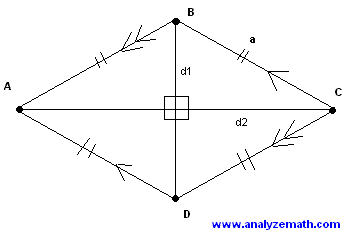
A rhombus is a parallelogram with four congruent sides and angles

- The diagonals of a rhombus are perpendeicular
- The diagonals bisect the angles
- They bisect each other


A rectangle is a parallelogram with four congruent angles also called an equiangular parallelogram

-The diagonals of a rectangle are congruent ands bisect each other

A square is an equilateral rectangle or regular quadrilateral or an equiangular rhombus

-A square's diagonals are congruent, perpendicular & they bisect each other.


Resources:
http://www.analyzemath.com/Geometry/rhombus_1.gif
https://blogger.googleusercontent.com/img/b/R29vZ2xl/AVvXsEg33UNJHn2qgmKLlEmfdl5gWiTqg0So6hdwpnVIRRolCI0UH9mwuPEoAus_ZS4N8xf0WvRyEGnlT32YVvap1K_IBXX252UFw9gHPG3LWsDWa9QtAn0bu6XSTzaweBK8oPRZ6_Qqi8rFma1y/s1600/rectangle+18.PNG
http://www.google.com/imgres?um=1&hl=en&sa=X&tbo=d&biw=1366&bih=618&tbm=isch&tbnid=ZdYwe4YDYLWyGM:&imgrefurl=http://www.geom.uiuc.edu/~dwiggins/conj28.html&docid=L8um8FYz5pA4mM&imgurl=http://www.geom.uiuc.edu/~dwiggins/proof29.GIF&w=364&h=196&ei=LWj5UOXEL6mB0QGooIDIBw&zoom=1&iact=hc&vpx=2&vpy=179&dur=1887&hovh=156&hovw=291&tx=225&ty=48&sig=114690899695513863037&page=1&tbnh=137&tbnw=256&start=0&ndsp=18&ved=1t:429,r:0,s:0,i:122

Are there any other special shapes?

Tuesday, December 11, 2012

How do we use the properties of parallelograms?

Parallelogram: A quadrilateral with 2 pairs of parallel sides.

 Properties
  • The opposite sides are congruent.  
  • Consecutive angles are supplementary. Example: 
  • The opposite angles are congruent. 
  • Diagonals bisect each other 
            • Not always congruent
            • Not always perpendicular 


http://www.wyzant.com/Help/Math/Geometry/Quadrilaterals/Properties_of_Parallelograms.aspx
http://ef004.k12.sd.us/ch8notes.htm
http://www.ck12.org/user%3AYWtlZWxlckBhY2VsZnJlc25vLm9yZw../book/ACEL-Geometry-2012-2013/r2/section/6.5/Proving-Quadrilaterals-are-Parallelograms/

Friday, December 7, 2012

How do we use properties of trapezoids?


12.7.12

First thing to know is what is a trapezoid.
  • A trapezoid has exactly one pair of parallel lines
 
Properties of trapezoids
  1. Trapezoid Consecutive Angles Conjecture                                                                                         -The consecutive angles between the bases of a trapezoid are 180 degrees (supplementary).

     2. Isosceles Trapezoid Conjecture 
         - The base angles of an isosceles trapezoid are congruent.
<A is congruent to <D.

Try solving this:  Find x.

  
1st step: 2x+5=3x+2
2nd step:subtract 2x from both sides
                                                    Equation should look like this: 5=x+2
3rd step: subtract 2 from both sides and you get your answer.
                                                    Answer is 3+x
* You don't do this to 4x-2 and 5x+3 because those are parallel not congruent.


1st picture from http://www.google.com/imgresum=1&hl=en&tbo=d&biw=1517&bih=693&tbm=isch&tbnid=sGz7fgFw41GoMM:&imgrefurl=http://www.ck12.org/concept/Trapezoids---Intermediate/&docid=eeMQ8dVhvkcDNM&imgurl=http://www.ck12.org/flx/show/image/user%25253Ack12editor/201209241348511282764513_dff7a8f97ef56047035788567c45fc33-201209241348512460267699.png&w=708&h=511&ei=MabCUMukGPC10AGlqYG4Aw&zoom=1&iact=hc&vpx=4&vpy=274&dur=292&hovh=191&hovw=264&tx=128&ty=97&sig=108818101793549926599&page=2&tbnh=145&tbnw=202&start=27&ndsp=38&ved=1t:429,r:42,s:0,i:215
2nd picture from http://www.geom.uiuc.edu/~dwiggins/conj22.html
  
WHAT ARE THE RHOMBUS'S CONJECTURES?

Saturday, December 1, 2012

How do we use triangle congruency?

11.27.12

Corresponding Parts of Congruent Triangles are Congruent

Don't get what it means. No problem

  •  It means that if the triangles are congruent, so are the parts of the triangle.
Still don't get it. Here is an example:
Given: Line Segment (LS) AB is congruent to LS DE; LS AB is perpendicular to LS BD; and, LS DE is perpendicular to LS BD. 
Prove: LS AC is congruent to LS EC 


Solution: 

*NOTE: AAS MEANS ANGLE ANGLE SIDE EXAMPLE: 
CPCTC MEANS CONGRUENT PART OF CONGRUENT TRIANGLES ARE CONGRUENT.

 Problem from :http://www.algebra.com/algebra/homework/Geometry-proofs/Geometry_proofs.faq.question.221424.html


Are there any other triangle congruency shortcuts?

Thursday, November 15, 2012

Aim: What are the congruence shortcuts?

11.14.12

Side-Side-Side Triangle Postulate(SSS)- If 3 sides of a triangle are congruent to 3 sides of another triangle, those two triangles are congruent.


Side-Angle-Side Triangle Postulate(SAS)-If 2 sides of a triangle and the INCLUDED ANGLE are congruent to the 2 sides of another triangle and its INCLUDED ANGLE, then the two triangles are congruent.
* Congruent angle must be between the congruent sides.


Angle-Side-Angle Congruence Postulate(ASA)-Triangles are congruent if any two angles and their INCLUDED SIDE are equal in both triangles.


Angle-Angle-Side Congruence Postulate(AAS)- Triangles are congruent if two pairs of corresponding angles and a pair of opposite sides are equal in both triangles.


What "congruence shortcuts" dont work on triangles?

Monday, November 5, 2012

Aim: How do we use the triangle inequality theorem?

11.5.12

Triangle Inequality Theorem: The sum of any 2 sides of a triangle must be greater than the measure of the third side.


Example: 
Side AB is 25
Side BC is 30
Side AC is 50

The sum of AB and BC is greater than AC.

Is there a similar theorem for angle in a triangle?